
Updated on February 19, 2026
If you’re searching for the best magnesium for sleep, you’re not alone. Magnesium has become one of the most discussed natural tools for improving sleep quality — and for good reason.
Unlike synthetic sedatives, magnesium works with your biology. It supports relaxation at the nervous system level, helps regulate stress hormones, and may promote deeper, more restorative sleep cycles.
But here’s the problem: not all magnesium forms are equal.
Some help sleep.
Some mainly help digestion.
Some barely absorb at all.
In this guide, we’ll break down exactly what makes the best magnesium for sleep, which forms work, and how to use it safely and effectively.
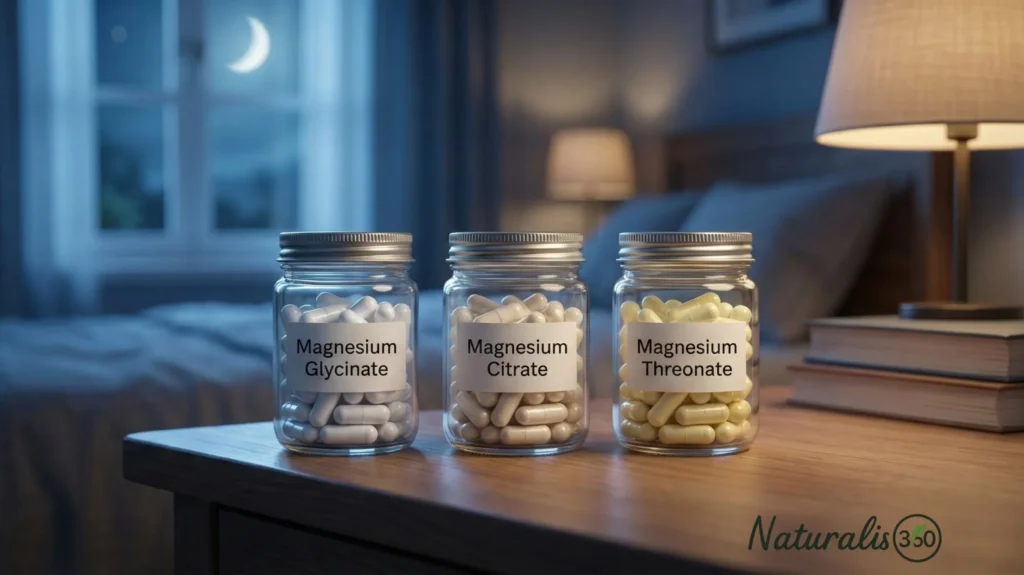
Why Magnesium Helps You Sleep
Magnesium plays a critical role in over 300 enzymatic reactions in the body — many of them directly tied to sleep optimization.
It helps:
- Regulate GABA (the brain’s calming neurotransmitter)
- Lower excess cortisol
- Relax muscles
- Stabilize the nervous system
- Support melatonin signaling
Low magnesium levels are associated with:
- Difficulty falling asleep
- Frequent nighttime awakenings
- Restless sleep
- Increased stress reactivity
If you’ve already read our pillar guide on Sleep Optimization 101 – The Science of Deep, Restorative Sleep, you know that deep sleep is where cellular repair and hormonal restoration occur. Magnesium helps create the internal conditions necessary for that deep phase to happen consistently.
What Makes the Best Magnesium for Sleep?
The best magnesium for sleep should meet three criteria:
- High bioavailability (well absorbed)
- Gentle on digestion
- Supports nervous system relaxation
Let’s examine the main forms.
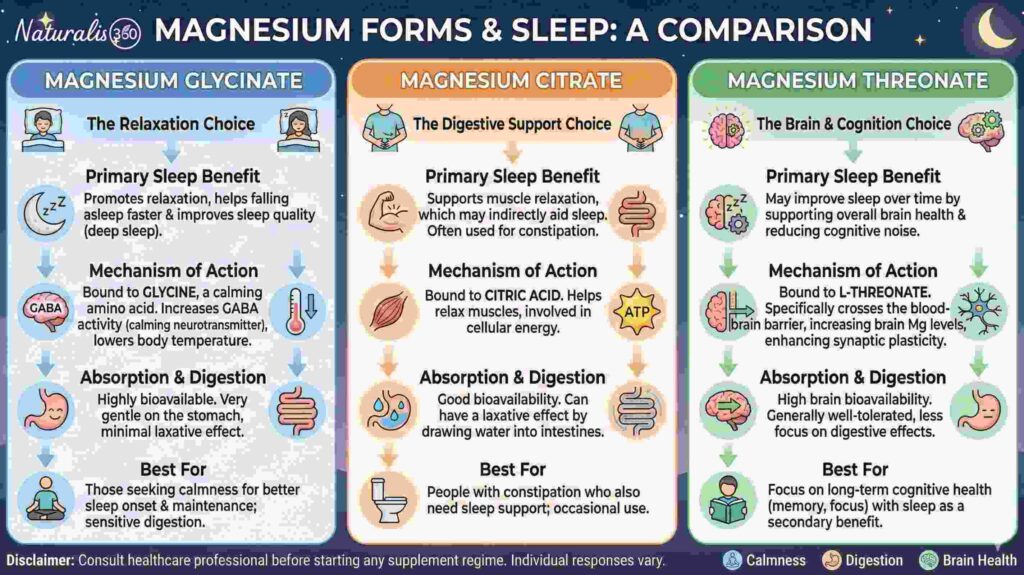
Magnesium Glycinate (Top Choice for Sleep)
Magnesium glycinate is widely considered the best magnesium for sleep.
Why?
Because it’s bound to glycine — an amino acid that itself promotes relaxation and may improve sleep quality.
Benefits:
- Highly absorbable
- Less likely to cause digestive upset
- Supports calm mood
- May reduce nighttime anxiety
Glycine has been shown to lower core body temperature slightly, which is important for sleep onset.
If you want the most targeted option for relaxation and deep sleep, glycinate is often the safest starting point.
(For a deeper comparison, see our guide: Magnesium Glycinate vs Citrate for Sleep.)
Magnesium Citrate (Good, But Not Ideal for Everyone)
Magnesium citrate is highly absorbable — but it’s more commonly used for digestive support.
Pros:
- Good absorption
- Affordable
- Widely available
Cons:
- Can have a laxative effect
- May not be ideal if digestion is already sensitive
If your main issue is constipation affecting sleep, citrate may help indirectly. But if your goal is purely relaxation, glycinate usually performs better.
Magnesium Threonate (Brain-Focused Option)
Magnesium threonate is known for crossing the blood-brain barrier more efficiently.
Potential benefits:
- Cognitive support
- Brain health
- May help mental hyperactivity at night
It’s more expensive and less studied specifically for sleep compared to glycinate, but it can be helpful for people whose insomnia feels mentally driven.
Forms to Avoid for Sleep
If you’re searching for the best magnesium for sleep, avoid:
- Magnesium oxide (poor absorption)
- Magnesium sulfate (primarily topical/Epsom salt)
- Low-dose blends with unclear labeling
Quality matters. Cheap magnesium often means low bioavailability.
How Much Magnesium for Sleep?
Typical supplemental ranges:
- 200–400 mg elemental magnesium per day
Most people start around 200–300 mg taken 30–60 minutes before bed.
Important:
More is not always better. Excess magnesium may cause digestive upset.
If you have kidney disease or take medications, consult a professional before supplementing.
Magnesium and Mitochondrial Energy
Sleep is not just about relaxation — it’s about cellular repair.
Magnesium plays a crucial role in ATP production inside mitochondria. If you’ve read our guide on Mitochondrial Dysfunction Symptoms and How to Fix Your Energy, you know that poor energy production often overlaps with poor sleep.
Magnesium deficiency can:
- Increase fatigue
- Reduce cellular energy output
- Worsen stress tolerance
Improving magnesium levels may support both nighttime recovery and daytime energy.
Combining Magnesium with Other Natural Sleep Supports
Magnesium works best as part of a broader strategy.
From our Sleep Optimization 101 guide, remember:
- Morning light anchors circadian rhythm
- Blue light reduction supports melatonin
- Regular schedule trains the brain to sleep
You may also consider pairing magnesium with:
- L-Theanine (calms racing thoughts)
- Glycine
- Proper sleep hygiene habits
If mental overstimulation is your biggest issue, read:
L-Theanine for Sleep and Relaxation (hiperlinkar após publicar)
Magnesium + circadian alignment > magnesium alone.
Who Benefits Most from Magnesium?
Magnesium may be especially helpful for:
- People with high stress
- Those with restless muscles at night
- Individuals waking frequently
- Older adults (who often have lower magnesium levels)
- People consuming high caffeine
However, if sleep apnea, chronic insomnia, or severe anxiety is present, magnesium alone may not solve the issue.
Signs You Might Be Low in Magnesium
- Muscle cramps
- Eyelid twitching
- Fatigue
- Poor sleep
- Irritability
- High stress sensitivity
Modern diets are often lower in magnesium due to soil depletion and food processing.
Whole-food sources include:
- Pumpkin seeds
- Spinach
- Almonds
- Dark chocolate
- Avocado
But therapeutic levels are sometimes difficult to achieve through diet alone.
Evidence-Backed Benefits: Quantitative Data on Magnesium for Sleep
When choosing the best magnesium for sleep, it’s helpful to look at what the research says. Studies show that forms like magnesium glycinate and threonate can lead to measurable improvements in sleep quality, such as reduced time to fall asleep and more time in deep sleep stages.
For example, in a 2025 randomized trial, magnesium bisglycinate supplementation reduced insomnia severity scores by 3.9 points over four weeks, compared to 2.3 points with placebo, with a modest but noticeable impact.
This translates to a 28% improvement in self-reported insomnia severity for the magnesium group, highlighting its role in promoting relaxation without digestive side effects.
Another 2024 pilot trial found that magnesium supplementation boosted sleep duration, deep sleep, and overall sleep efficiency, along with better mood and heart rate variability, in adults with poor sleep. For magnesium L-threonate, a study showed improvements in deep sleep scores, REM sleep scores, and light sleep time, plus enhanced daytime energy and alertness.
Finally, a 2024 systematic review confirmed that magnesium often improves sleep quality and reduces anxiety, especially at higher doses or in those with low levels, across multiple trials. These findings reinforce why glycinate is often the top choice—it aligns with your body’s natural rhythms for deeper, restorative sleep.
Final Verdict: What Is the Best Magnesium for Sleep?
For most people, magnesium glycinate remains the best magnesium for sleep because it combines:
- High absorption
- Nervous system support
- Low digestive disturbance
- Calm-inducing glycine pairing
But remember: Magnesium is a tool — not a shortcut. It works best when layered into a full sleep optimization strategy.
Sleep is biology, not sedation.
Scientific References
- Schuster, J., et al. (2025). Magnesium Bisglycinate Supplementation in Healthy Adults Reporting Poor Sleep: A Randomized, Placebo-Controlled Trial. PMC. https://pmc.ncbi.nlm.nih.gov/articles/PMC12412596
- Breus, M. J., et al. (2024). Effectiveness of Magnesium Supplementation on Sleep Quality and Mood for Adults with Poor Sleep Quality: A Randomized Double-Blind Placebo-Controlled Crossover Pilot Trial. ESMED. https://esmed.org/MRA/mra/article/view/5410
- Hausenblas, H. A., et al. (2024). Magnesium-L-threonate improves sleep quality and daytime functioning in adults with self-reported sleep problems: A randomized controlled trial. PubMed. https://pubmed.ncbi.nlm.nih.gov/39252819
- Rawji, A., et al. (2024). Magnesium can improve sleep quality and reduce anxiety: A systematic review. ICNS. https://www.icns.es/en/news/magnesium_improve_sleep_reduce_anxiety