
Updated on december 08, 2025
You don’t lose your energy overnight, but ignoring mitochondrial dysfunction symptoms can speed up the process. For most people, the decline is subtle — a slow fading of mental clarity, stamina, and resilience that feels like “getting older,” even when age isn’t the real problem. Long before blood tests show anything unusual, your mitochondria start to underperform. And when these tiny engines falter, your entire body feels it.
Mitochondria are responsible for turning oxygen and nutrients into usable energy. When their output drops, the very systems that keep you sharp, strong, and emotionally balanced begin to struggle. That’s why understanding the early signs of mitochondrial dysfunction is so important: the sooner you see the pattern, the sooner you can reverse it.
The Subtle Mitochondrial Dysfunction Symptoms Most People Miss
The first signs rarely look dramatic. You simply start noticing changes that feel “off,” even if you can’t explain them.
It might begin with that lingering tiredness that sleep no longer fixes… or the realization that tasks you once handled with ease now drain you.
Many people describe it as feeling like their internal battery is never fully charged.
As efficiency drops, distinct mitochondrial dysfunction symptoms begin to appear:
- Fatigue that sleep doesn’t fix
- Brain fog and slower mental processing
- Muscles tiring faster than before
- Frequent headaches or migraines
- Lower motivation and emotional resilience
- Digestive irregularities or unexplained discomfort
- That unsettling feeling of “aging fast” without a clear reason
These mitochondrial dysfunction symptoms don’t always scream “mitochondria,” but they are the earliest clues that your cells aren’t making enough ATP to keep up with the demands of daily life.

Why Your Energy Is Dropping (The Real Causes)
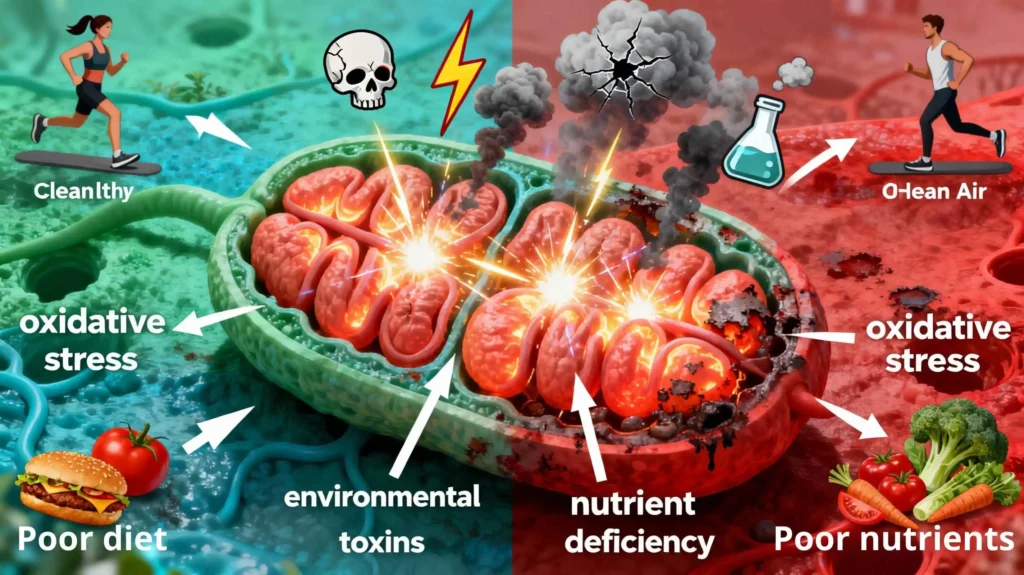
Mitochondria respond to the world you live in — and modern life is unusually harsh on them.
Chronic stress, inconsistent sleep, highly processed foods, pollution, viral infections, and long hours sitting all create a kind of “cellular wear” that slowly undermines energy production.
Over time, the cumulative load overwhelms the mitochondria’s ability to repair themselves. What was once occasional tiredness becomes a daily struggle. Workouts take longer to recover from. Concentration doesn’t come as easily. Your stress tolerance shrinks.
This isn’t aging.
It’s mitochondrial decline — happening earlier than ever before.
🔗 Related reading → Healthy Habits That Protect Mitochondria
When to Get Curious — and When to Seek Guidance
There is no single “mitochondria test,” but clinicians sometimes look for patterns that hint at cellular energy problems — things like abnormal organic acid profiles, elevated markers of oxidative stress, or low levels of CoQ10 or carnitine.
But in most cases, the decision to seek help doesn’t come from labs; it comes from noticing that these mitochondrial dysfunction symptoms are no longer occasional… they’re becoming your new normal.
Pay attention when:
- Your fatigue is progressively worsening
- Daily functioning is being impacted
- Brain fog is interfering with work or memory
- Recovery after exercise or illness feels unusually slow
- Neurological symptoms — tingling, migraines — begin to appear
- Several family members show similar signs
These early clues matter because mitochondrial dysfunction is far easier to correct when caught in the early stages.
How to Support Your Cells Before Problems Escalate
Supporting mitochondria isn’t complicated — it’s about removing the friction your cells are facing while giving them the raw materials they need to repair and produce energy.
To begin supporting your mitochondria, focus on the fundamentals: prioritize consistent, restorative sleep; eat foods naturally rich in antioxidants such as berries, olive oil, turmeric, green tea, and leafy greens; move your body every day, even if it’s just a light walk; reduce exposure to unnecessary toxins and chronic stress; and get morning sunlight to help regulate the circadian rhythm that drives cellular repair.
These habits alone begin to shift mitochondrial output — but for many people, especially those already experiencing symptoms, lifestyle support isn’t enough on its own. Mitochondria often need additional help in the form of targeted nutrients.
Compounds like CoQ10, PQQ, B-vitamins, ALA, and L-Carnitine don’t hype you up like caffeine — they help your cells remember how to create real energy again. If you’ve been feeling drained and want to understand the nutrients that can truly support your mitochondria, dive into our full breakdown: Mitochondrial Vitamins: The Essential Nutrients for Cellular Energy.
When used consistently, these nutrients can complement your lifestyle changes and accelerate recovery from early mitochondrial decline.
The Role of Advanced Antioxidant Support
If early symptoms are already appearing, your cells may benefit from more concentrated support. That’s where blends like Mitolyn come in.
Mitolyn is a plant-based antioxidant formula built around six rare bioactive ingredients — including maqui berry, rhodiola, and astaxanthin-rich microalgae — formulated to support healthy mitochondrial levels, reduce oxidative burden, and help restore a smoother, more stable energy profile.
It doesn’t rely on stimulants.
Instead, it gives your cells ingredients that help reduce stress at the mitochondrial level — where the problem begins.
If you want a supplement specifically designed to help your mitochondria perform better, Mitolyn delivers a natural blend of rare antioxidants chosen for cellular energy support. 👉 FIND HERE
Final Thoughts
Your mitochondria are always communicating with you — through your energy, your clarity, your stamina, your emotional resilience.
When these begin to slip, it’s not random. It’s the earliest signal that your cells need help.
By understanding the signs and supporting your mitochondria before deeper dysfunction develops, you can protect your long-term vitality and reclaim the energy you thought you’d lost.
Small shifts today → powerful energy tomorrow.